Beyond The Code
Until It Arrives, Fulfilment Is the Brand
With Shoaib Ahsan · 5 min read
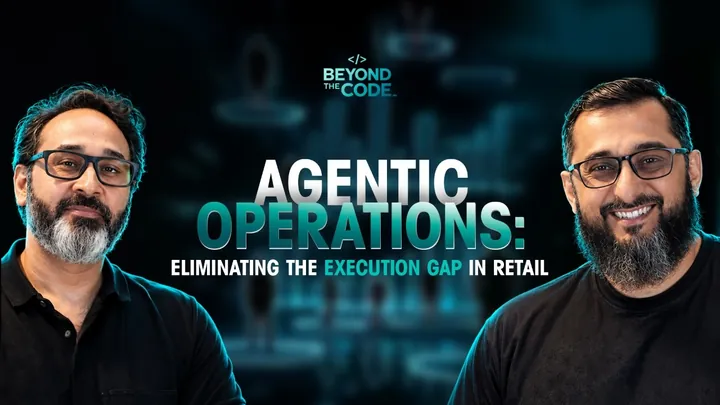
A conversation with Shoaib Ahsan, founder and CPO at Firaasa (formerly Unity Retail), on the gap between seeing a problem and acting on it, why so much retail still runs like a storeroom, and what fulfilment does to a brand.
Full disclosure: I am a strategic advisor to Firaasa.
I invited Shoaib Ahsan onto the second episode of Beyond The Code to talk about agentic AI in retail. He opened by calling himself an extraordinarily average person. I don’t buy it. He left his job in 2016 with no business background in the family to lean on, and has spent the ten years since on one quiet question: what happens to an order after the customer clicks buy. I have worked on the courier side of that problem myself, so I thought I knew where this would go. It went somewhere more useful.
Throwing people at it
One line has stayed with me since we recorded: “Our response as a nation to scaling up is to throw more people at it.” It describes a default. A business grows and the answer is another hire, until you have an army doing work a system should do.
His own company works with what he called “such a huge clientele”, and the team is eight people. He should practise what he preaches, he said. Turning up with an army of 80 people himself would defeat the point. For his clients, he said, businesses that got out 1,000 orders a day reached 5,000 to 10,000 with the same people. His figures, not mine, but I believe the direction. Headcount buys you time. It rarely buys you scale.
The gap between seeing and doing
Shoaib said that in most of these businesses, the time between seeing an event and reacting to it “is still too long”. His contrast was Zara: a trend appears, and within seven days something based on it is in their shops around the world. Here, he said, we are still deciding next year’s summer lawn designs a year ahead.
His fix has two halves. First, honest reporting: dashboards, he said, are often there to please management. He wants to give them “the true unfiltered reality and tell them what they are missing”. Second, let the system act. “Every courier has cyclical ups and downs,” so when one courier’s KPIs start to slip, his system moves the work to another one. Waiting two weeks to notice, he said, could mean another 8 crore rupees stuck with that courier.
That is what agentic means to me in practice. Not a smarter chart. A decision made when the data changes, with the merchant still free to take control back.
From godam to warehouse
Shoaib said we are “still migrating from a godam mentality into a warehouse mentality”. A godam is a storeroom, where very little is managed. In a typical morning the team waits three to four hours for printouts and labels before anything moves. His system runs on management by exception: “you don’t fix what’s not broken.” Orders that fit a known pattern go straight to a picker’s app, and the picker logs in and starts.
Every warehouse also has an Arshad Bhai, his name for the zone manager who knows where everything is. The day Arshad Bhai doesn’t come in, the work doesn’t get done. Shoaib moved that knowledge into the system, simple enough that daily labour for a big sale can be trained in about five minutes.
Then the wrong number. Warehouse teams, he said, optimise for quantity, not business value. They clear the simple picks first and report 80 per cent fulfilled when, by value, it may not even be 20. His system ranks the work by ageing, order value and same-city delivery instead. This isn’t only a warehouse problem. Any team will hit the number it is measured on.
The expensive subscription
Usually, Shoaib said, you sell the software and say goodbye. His team does the opposite: “We put in the greatest amount of effort in the onboarding and implementation phase.” Skip that, and “it’s just going to end up as being a very expensive subscription”.
That means agreeing the process with every department before go-live, then two to three weeks of hypercare and daily reconciliation across systems. Some clients balk at what they charge for it. I would rather pay for that than for licences nobody uses.
He also gave me the most honest engineering line I have heard in a while: “We try to put effort into something just once. We are very lazy.” With eight people, solving a problem once isn’t a philosophy. It is the only option.
Not scared of too many orders
The case study was Highfy, a skincare and cosmetics business doing well on volume but stuck on fulfilment and inventory. Orders went out partial, and with 25 pencils that all look the same, wrong items went out and returns piled up.
What struck me was where he looks first: the customer’s complaints. I told him it was the first time I had heard of a fulfilment company using end-customer feedback to find a merchant’s problems. His answer to owners who see all this as cost cutting is direct: “You can only grow your business by delivering a good customer experience.” Until the product is in the customer’s hands, your fulfilment experience defines that experience.
On go-live day, Highfy’s founder, Hanzala, picked the first order himself, in about two minutes. Before, the fear was getting too many orders. Afterwards, Shoaib said, the fulfilment team was asking for more.
Keep the intention right
I closed by asking what he would tell his 18-year-old self. He said it will all work out if you keep your intention right and work with sincerity. He put the daily version of it like this: “I should actively be looking out for what benefit I can give them without expecting anything in return.”
A team that solves things once and an implementation that doesn’t stop at the sale both come from the same place: caring about what happens after the handshake. The execution gap was never mainly a technology problem. It is what’s left when nobody owns the outcome.
Thanks to Shoaib Ahsan for the conversation, and for being so open about how the work happens. Watch the full episode on YouTube.
In this episode
- 00:00 Introductions
- 07:03 From godam to warehouse
- 11:17 Throwing people at it
- 14:54 The gap between seeing and doing
- 19:42 Onboarding and the expensive subscription
- 25:46 Management by exception on the warehouse floor
- 31:22 Optimising for the wrong number
- 35:02 The Highfy case study
- 44:35 Advice to his 18-year-old self